

Third Journey : South-Africa
Heading to the land of Nelson Mandela and the Sestigers!
7/14/2025
On the cover: Drakensberg Mountains in KwaZulu-Natal
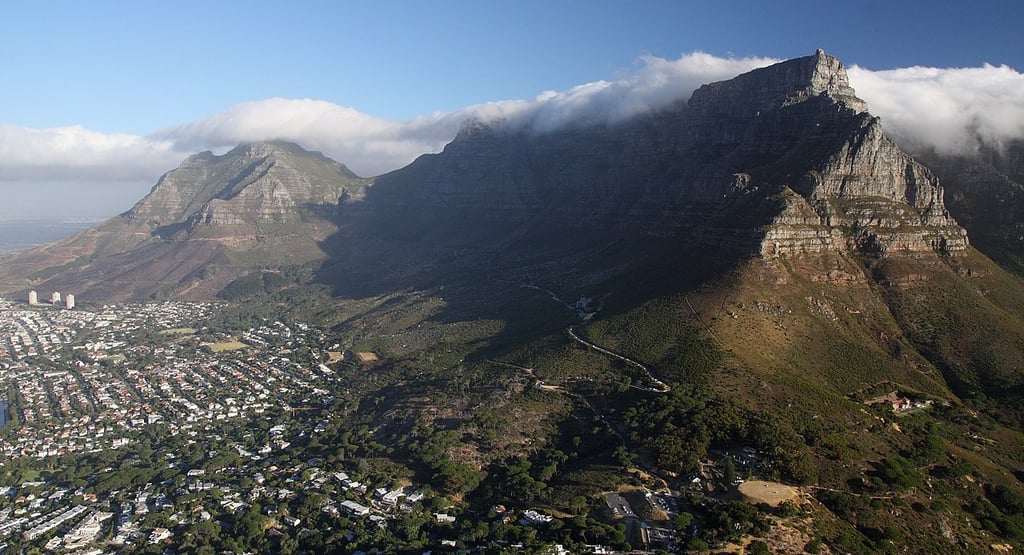
Above: Table Mountain in Cape Town
A Multicultural Country
South Africa is a country rich in culture and history. With over thirty ethnic groups and twelve official languages, providing a brief description seems impossible. To gain some clarity, here are the (more or less) general books I have selected:
History of South Africa: From the Origins to the Present Day (Histoire de l'Afrique du Sud, des origines à nos jours) by Gilles Teulié, professor at Aix-Marseille University. The idea is to get an initial overview of the country's history, which is not limited to the apartheid and post-apartheid periods.
In the Land of the Kafirs and the Zulus (Au pays des Cafres et des Zoulous) by Roger Guérin. Published in 1888, it deals with the Zulus, the second-largest ethnic group in South Africa, and the Kafirs, which according to Wikipedia refers to "the indigenous cultures of South Africa, used in French as a synonym for Nguni, a group that includes the Zulus (Kafirs of Natal) and the Xhosas (Kafirs of the Cape)." The Xhosas are the largest ethnic group in South Africa. This book will probably feel dated but remains a potentially interesting testimony.
Let's Speak Xhosa South Africa (Parlons xhosa Afrique du Sud) by Zamantuli Scaraffiotti, which promises an introduction to Xhosa culture.
Ndebele by Margaret Courtney-Clarke. The Ndebele people live in the Transvaal, and their art is now known worldwide. This book focuses on the art of the women of this people and appears to be rich in illustrations.
Since apartheid is a crucial topic for understanding 19th-century South Africa, I chose a classic approach to the subject : Nelson Mandela. He is an essential figure, and I plan to dedicate three readings to him :
Nelson Mandela: A Man of Destiny (Nelson Mandela : Un homme d'exception) by Anthony Sampson. This is a photographic book presenting Mandela’s actions and struggles.
The Prison Letters of Nelson Mandela (Les lettres de prison de Nelson Mandela) to access his direct thoughts. Mandela spent 27 years in prison, and his published correspondence spans over 700 pages, providing a deep insight into his thinking.
Cuba and Africa: The Victory of Equality (Cuba et l'Afrique, victoire de l'égalité) by Nelson Mandela and Fidel Castro, written in 1991. As we will encounter Fidel Castro again in future journeys, I’m curious to understand his relationship with Mandela.
A Rich and Accessible Literary Tradition
The late 19th and early 20th centuries marked an explosion of literature in South Africa, in all languages. Furthermore, since English is one of the country’s official languages, many works have been translated into English, making them more accessible in France. The abundance of resources makes it difficult to navigate, and trying to read all the important works could fill an entire lifetime.
To start, I chose Mhudi: An Epic of South African Native Life a Hundred Years Ago by Solomon Plaatje (1876-1932), as it is the first fiction book written by a Black South African. Staying with anglophone literature, the journey will also include :
The Story of an African Farm (Histoire d'une ferme africaine) by Olive Schreiner, published in 1883 and highly successful at the time, narrating life on a South African farm.
Cry, the Beloved Country (Pleure, ô pays bien-aimé) by Alan Paton, a Black Anglican pastor, which was a bestseller when it came out in 1948.
From Nadine Gordimer, I’ll read The Conservationist (Le conservateur), July’s People (Ceux de July), and The Soft Voice of the Serpent (La voix douce du serpent). Gordimer, a white anglophone, won the Nobel Prize for Literature in 1991. Initially, I intended to read only two of her books, but discovering that The Soft Voice of the Serpent is a short story collection, I couldn’t resist adding it.
Mongane Wally Serote is "perhaps the greatest Black South African poet of his generation, and throughout his career, his poetry has always been political, committed, and liberational." I’ll read Shebeen Blues.
Ways of Dying (Au pays de l'ocre rouge) by Zakes Mda, born in 1948 and the recipient of several South African literary prizes.
Another major literary language is Afrikaans. We’ll thus explore:
The Soul of the White Ant (Die Siel van die Mier) by Eugène Marais, published in 1937. Marais was part of the community of French Huguenot descendants who emigrated to South Africa to escape Protestant persecution.
Leipoldt's Food and Wine by Louis Leipoldt, one of the most important Afrikaans writers.
Triomf by Marlene van Niekerk, an Afrikaner of the new generation. This book addresses the poverty of whites before the establishment of the multiracial government.
Specifically concerning Afrikaans, I want to explore the literary movement known as the Sestigers or Beweging van Sestig in Afrikaans, literally the Movement of the Sixties. Here’s Wikipedia’s definition:
“The Sestigers sought to elevate Afrikaans to the rank of a literary language and to use it as a means to express their dissident convictions against the extremist, white supremacist Nationalist Party in power, especially its apartheid policies and censorship practices. Before their efforts, the Afrikaans language and culture seemed closely tied to the repressive regime. Members of the Sestigers often had to go into exile. This group of authors was notably influenced by French literature.”
This is a golden opportunity to discover a foreign literary movement. The movement was initiated by Breyten Breytenbach and André Brink, so I will read The True Confessions of an Albino Terrorist (Confessions véridiques d'un terroriste albinos) and A Dry White Season (Une saison blanche et sèche). I’ll also add My Traitor's Heart: A South African Exile Returns to Face His Country, His Tribe, and His Conscience (Mon cœur de traitre. Le drame d'un afrikaner) by Rian Malan and A Strange Country (En étrange pays) by Karel Schoeman. These latter two are more recent, allowing insight into what became of the Sestigers.
Let’s not forget African languages, which are unfortunately harder to find compared to their diversity and number of speakers:
Thomas Mafolo (1876-1948) wrote in Sesotho. Although he lived in what is now Lesotho (created in 1966), an enclave within South Africa, he traveled extensively in South Africa. I’ve selected two titles from him: Chaka: An Epic of the Zulu Empire (Chaka, une épopée bantoue) and The Man Who Walked Towards the Rising Sun (L'homme qui marchait vers le soleil levant).
Popular Tales of the Basutos - South Africa (Contes populaires des Bassoutos - Afrique du Sud), an anthology published initially in 1895 and compiled by Edouard Jacottet. There is little information on this book, so I’m unsure what to expect.
The Ancestors and the Sacred Mountain and Other Writings (Les ancêtres et la montagne sacrée et autres écrits) by Mazisi Kunene, who wrote in Zulu.
Inzuzo by Samuel Edward Krune Mqhayi, who died in 1945 and wrote in isiXhosa, the language of the Xhosa people.
See you soon for the reading journal!