

Sixth Journey : Germany
A journey to a country bordering France!
4/27/2026


Johann Wolfgang von Goethe
A Relatively Familiar Country
By virtue of its geographical proximity to France and its prominent place in the school curriculum, Germany is a country about which I already have some historical knowledge. At the same time, German literature enjoys a fine reputation among French readers, which has already led me to read a few of its works. In short, I need here to adapt my usual method somewhat.
From a historical standpoint, I am deliberately excluding books dedicated to the Second World War — not because I know it perfectly, but because I have already read several books on the subject, not counting school history lessons. In any case, I expect every piece of 20th-century writing to mention it, from various angles.
As usual, I have chosen a general survey — here Une nouvelle histoire de l'Allemagne by Marie-Bénédicte Vincent. I will pair it with a second book that seems perfectly suited to Voyages Livresques: Une histoire de l'Allemagne au fil des textes - De Luther À Helmut Kohl by Sophie Lorrain, which turns out to be an anthology of great German texts.
On the ethnological side, Germany will be my first point of contact with the Roma people, on whom it is difficult to find reliable sources. I have kept APetite histoire du peuple Rrom, première diaspora historique de l'Inde by Marcel Courthiade. Since it is not possible to truly attach the Roma to any one specific country, I will sprinkle their history and literature across the European countries as I go.
Speaking of populations for whom sources are hard to find, the Sorbs (also known as Lusatian Serbs) are strong contenders for a high ranking on that list. There are certainly more accessible sources on them than on certain South African peoples, for instance, but I am surprised to have had such difficulty finding writings about a people who live in a country bordering metropolitan France. The Sorbs are a Slavic people living in eastern Germany, speaking Sorbian (closely related to Czech, Polish, or Slovak), and numbering between 60,000 and 80,000 individuals. In Lusatia, as in Brittany in France, street signs and place names are also written in Sorbian. Put simply: I could not find a single book on the Sorbs published in French, nor have any of their major authors been translated. The roundabout route I found was to compile research articles in history and sociology and print my own personal-use book :
Here is the list of compiled articles:
Anatole Danto, "La Lusace, pays d'étangs : usages traditionnels de l'eau et nouvelles pratiques en territoires sorabes (Länder de Brandebourg et Saxe, Allemagne).", Revue Géographique de l'Est, vol. 56/1-2, 2016
Isabelle Solères, "La minorité sorbe du Brandebourg vue par l’écrivain prussien Theodor Fontane (1819-1898)", Mémoire(s), identité(s), marginalité(s) dans le monde occidental contemporain, 2, 2006
André-Louis Sanguin, "Les Sorabes de l'Ex R.D.A. après la fin du communisme", Revue d'études slaves, LXVIII, 1996
Hélène Yèche, "Image et instrumentalisation de la culture sorabe dans lʼancienne RDA", Revue du Centre Européen d'Etudes Slaves, no. 1
Jean Kudela, "Comment les écrivains sorabes ont perçu la RDA", Revue d'Allemagne et des pays de langue allemande, 51-1, 2019
Nicole Dołowy-Rybińska, "L’autoportrait des jeunes Sorabes et Kachoubes : identité culturelle et choix linguistiques", Mémoire(s), identité(s), marginalité(s) dans le monde occidental contemporain, 13, 2015
Jean Kudela, "Une saga sorabe", Revue des études slaves, LXXXV-2, 2014
Dietrich Scholze, "Le théâtre amateur des Sorabes de Lusace", Revue des études slaves, LXXXV-2, 2014
Měrćin Wałda, "Le noyau catholique sorabe", Revue des études slaves, LXXXV-2, 2014
Jan Malink, "Les protestants sorabes", Revue des études slaves, LXXXV-2, 2014
Hélène Yèche, "Les Sorabes : une minorité invisible ?", Belgeo, 3, 2013
Ludwig Ela/Elle, "Situation juridique et politique des Sorabes de Lusace : derniers développements", Revue des études slaves, LXXXV-2, 2014
Jean Kudela, "La question sorabe dans l’Allemagne contemporaine", Mémoire(s), identité(s), marginalité(s) dans le monde occidental contemporain, 13, 2015
A brief detour into philosophy with La Philosophie allemande : de Kant à Heidegger edited by Dominique Folscheid. In the same vein, how could one overlook Marx and Engels's Manifeste du Parti communiste ? The first five countries of Voyages Livresques have all been touched by communism, to varying degrees, and I expect only a modest decline in that frequency going forward.
Somewhat Partial Literary Choices
Having already some familiarity with German literature, I have chosen titles I have previously heard of and that are likely to appeal to me.
For older literature, I turned to the Chanson des Nibelungen, a 13th-century epic recommended on several occasions by Jorge Luis Borges in his literature lectures. My second choice fell on Les aventures de Simplicissimus by Hans Jakob Christoffel von Grimmelshausen, first published in 1699. This text is described as the Don Quixote of German literature — essential reading, therefore.
I will then read two works by Goethe: Faust and Les souffrances du jeune Werther.
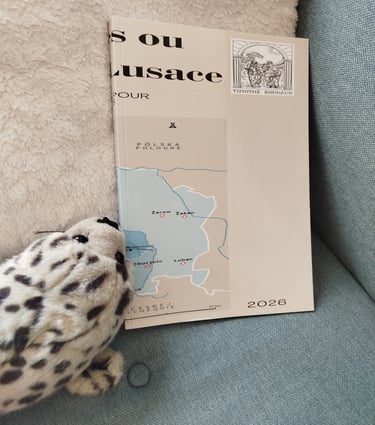
[Note: the cover of my self-printed Sorbian compilation is quite something — the printer even contacted me to make sure I knew it was going to look terrible. Even the seal appears to be in shock.]