

Reading Journal : Algeria
Summary of the literary journey through Algeria
4/26/2026
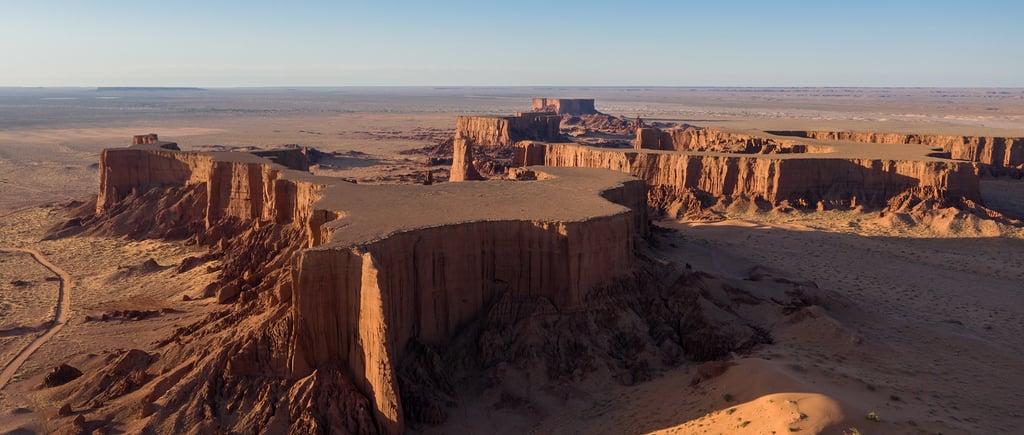
The Algerian Sahara
Some Doubts About a Book
The history and sociology books selected complement each other fairly well. As a reminder:
Histoire de l'Algérie coloniale by Benjamin Stora
Histoire de l'Algérie depuis l'indépendance by the same author
Sociologie de l'Algérie by Pierre Bourdieu
L'olivier en Kabylie entre mythes et réalités by Rachid Oulebsir
Possession, magie et prophétie en Algérie by Aissa Ouitis
Les archs tribus berbères de Kabylie, Histoire, résistance, culture et démocratie by Youcef Allioui
When the first five contradict one another, it only concerns minor points, explainable by differences in the populations studied or by methodological developments over time — the oldest and newest books being separated by fifty years.
The sixth, Les archs tribus berbères de Kabylie, stands entirely apart from the others, to the extent that it describes an Algerian society and Kabyle traditions that differ markedly from those presented elsewhere. In short, the book describes paradise on earth — a lost paradise, certainly, but paradise nonetheless. The author depicts the ancient Kabyle society (which French colonisation and the Algerian government worked tirelessly to destroy) as a perfectly egalitarian society, socially and economically, where no one goes hungry thanks to a well-oiled system of mutual aid, where total freedom of thought prevails, where Islam has made only shallow inroads due to the survival of pre-Islamic Kabyle beliefs, where women stand on equal footing with men — or even in a dominant position — and where religion occupies only the place of a shimmering tradition, never tipping into superstition.
There are troubling aspects to the author's argumentation: many facts are sourced by nothing more than a reference to "the elders of the village," anecdotes from his grandparents, or personal experience — even if the work broadly aims to follow academic conventions. This does not necessarily mean the facts are false, simply that it is harder to verify them objectively.
Another weakness in the argument is the recurring recourse to the presumption of conscious social choices made in the pursuit of a secular and democratic society. On several occasions, the author presents social facts which, if real, would suggest Kabyle society is democratic and secular, and explains that the Kabyle people made a very precise series of deliberate decisions to achieve this outcome — without demonstrating the reality of that deliberateness.
Finally, the determination to present Kabyle society as perfectly egalitarian and classless leads the author to argue that the fact that the Kabyle once kept slaves does not undermine this claim, since those slaves were relatively well treated. My resistance may be irrational, but I genuinely struggle to imagine a society that practised slavery as egalitarian — I would need exceptionally well-founded evidence to accept this.
To get to the heart of the contradiction, two points give me serious doubt about the thesis put forward in Les archs tribus berbères de Kabylie.
The first is the complete omission of Kabyle superstitions. Possession, magie et prophétie en Algérie by Aissa Ouitis is, beneath its enticing title, primarily a sociological thesis on Kabyle society. The author describes several traditions: the frequent recourse to talebs for removal of curses, women's use of magic to make or break marriages, the rifle ceremony marking a boy's passage to manhood, the tradition of the knife which can (magically) cause impotence in a man on the eve of his wedding night, and so on. None of these traditions or beliefs are mentioned in Les archs tribus berbères de Kabylie, as if the author wished to conceal them — which is strange in a book subtitled History, Resistance, Culture and Democracy.
The second concerns the place of women in Kabyle society. One of the central hypotheses of Aissa Ouitis — who notes that in Kabylia, magic is primarily a female domain — is that this can be explained by women's attempt to gain power through supernatural forces, power they are entirely denied in society by ordinary means. According to Ouitis, Kabyle women are dominated by men in every aspect of life. Rachid Oulebsir shares this view and raises it in his analysis of olive culture in Kabylia. Bourdieu too, without dwelling on it at length and perhaps with greater nuance, notes the disadvantaged position of women in Kabyle society — specifically on the matter of inheritance (women are disinherited) — and provides the anthropological explanations for this state of affairs. Further afield, this inequality also appears in the literature: Kateb Yacine addresses it as well.
As a final point, Youcef Allioui himself acknowledges that women had no direct political power, but argues that, possessing strong influence over men (a claim not attested in the other writings), they were in reality first-rank decision-makers.
The book could also be criticised on the question of religion, given the numerous contradictions with other studies on the subject.
In conclusion, I nonetheless recommend Les archs tribus berbères de Kabylie, which presents in detail many aspects of Kabyle society and its history — but only on the condition that it is accompanied by other readings to counterbalance its partisan character and provide a more accurate picture of that society. I also recommend it for the pleasure of comparing sources and exercising critical thinking.
A Novel of Prominent Themes and Remarkable Poetry
Fiction
A few themes emerge from my reading sample, present in almost every novel I read: hunger, sexuality, the place of women, Islamism, colonial injustice, and the injustice of the post-independence state. Rather than grouping them thematically or stylistically, it is easier to picture them as a heat map across subjects.
La répudiation by Rachid Boudjedra focuses primarily on twisted sexuality (paedophilia, incest), with its protagonist slowly losing his mind — if he ever had it. The style reflects this confusion well; it is heavy reading, but possesses a unity that commands respect, with real craft in the representation of sensation. Although it was not my favourite read, I can easily see it as a thematic extreme of the Algerian novel.
To continue the metaphor, the thematic extreme of the independence war might be L'opium et la bâton by Mouloud Mammeri, in that it presents numerous Algerian trajectories — from the convinced to the almost accidentally enlisted, including a liaison agent and a collaborator (who is without doubt the most interesting character). Also worth noting is its single-breath structure despite the multiplicity of voices, which conveys the interweaving of destinies. One of my favourite books from this journey, and one that pairs well with La grande maison by Mohammed Dib — the extreme of famine — in which we follow the daily life of a young boy and his family suffering from hunger. It is a natural companion because that hunger leads the boy to lend an attentive ear to pro-independence voices, despite his young age.
A natural link leads to Le fils du pauvre by Mouloud Feraoun, as it also recounts the life of a child during the pre-independence period, likewise suffering from hunger and a hard life. The style is far more Pagnolesque, and it makes for a very good read — but Dib works his theme more obsessively, making La grande maison more memorable. However, Le fils du pauvre takes a broader view and portrays the lives of women before independence with greater care.
On the pre-independence period, I must mention Nedjma by Kateb Yacine, which is interesting for its circular structure — disorienting the reader's sense of bearings — and for what it offers on Algerian ways of life during the colonial era. Another interesting dimension is Nedjma's position, which opens onto reflections on the role of tribes within a social model imposed by Europe. The ideas are fairly complementary to those of Alan Paton in Pleure Ô mon pays bien aimé, and while the two never read each other, it represents a potentially sad case of a friendship missed. That said, I did not particularly enjoy Nedjma, unlike Pleure Ô mon pays bien aimé — probably due to excessively high expectations.
For the post-colonial extreme, my heart is torn between Les vigiles by Tahar Djaout and Le fleuve détourné by Rachid Mimouni. Both carry this critique of the Kafkaesque state — Les vigiles with its hero trying to patent his invention while battling a bureaucracy worthy of Kafka's The Trial and religious opposition, alongside the atmosphere of purges that so often follows independence (it reminded me strongly of the communist party's rise to power in Albania); Le fleuve détourné with its protagonist declared administratively dead during the war, wondering what has become of all his compatriots and doing his best to try to resurrect himself. The critique of the post-colonial state and its entanglement with a totalitarian form of religion is a theme addressed in every novel I read set after independence, and it is perhaps Les vigiles that best embodies it. Anyone who has enjoyed Kafka's The Trial can go straight to Les vigiles — they will not be disappointed, finding that exact flavour of powerlessness in the face of a dangerous administration with obscure workings.
For the extreme of religious tension, I initially expected this place to be filled by Le serment des barbares by Boualem Sansal, but I enjoyed this novel so little that I could not finish it — I stopped at page 200, halfway through. The style is very heavy and difficult to read, without that difficulty serving the subject in the way it does in Boudjedra. I struggled to identify what theses Sansal is advancing here, could not get into the story, and decided to stop.
I would rather place at this point the book by Tahar Ouettar, Noces de mulet. Its hero embodies the ambivalence of religion in Algerian society as depicted in the literature: he is a mystic and an attentive devotee, performing all his daily prayers with the utmost care, but also a hardened pimp and the pillar of a brothel. Worth noting: he achieves his mystical experiences with the aid of hashish, and spent twenty years in a penal colony for multiple murders — after studying theology. A true gem of Algerian literature.
To close this heat map, I should emphasise that none of these works is confined to its own dominant theme. One stood out more than the others: Le fleuve détourné. This novel is a synthesis of all the others — sexuality (zoophilia, incest), hunger, war, heroism, the post-colonial state, religion — everything is here, and one is compelled to recognise Rachid Mimouni's genuine gift for the well-turned phrase. The icing on the cake for me: the novel dips into a form of magical realism quite unexpectedly. Here is a quote that captures it all, as a skeleton replies to the protagonist's question:
"I'm sorry, I can tell you nothing. Still less advise you. Don't go thinking the dead know a great deal. Not the slightest secret. Buried in darkness, cold and damp. The maggots have eaten our flesh. An invisible swarm of microbes is busy making our bones disappear. Soon we will be nothing at all. The living must stop this habit of making us the custodians of the secret of the human condition. I'm sorry, I can tell you nothing. It was good to see you. Thank you for the tobacco."
And what of Mémoire de la chair by Ahlam Mosteghanemi? Due to a misunderstanding with the postal service, I never managed to retrieve the book — and ultimately did not read it...
Tales & Poetry
On the two collections of tales, I have little to say, apart from my surprise at the omnipresence of the ogress figure, which I did not find in the novels. The difficulty of reading these tales — as with those of the Basotho — several decades after they were collected, in an entirely different cultural context, is that it is hard to know what they are really communicating: are they meant to teach something? To entertain? To frighten? Impossible to say.
On the poetry, however, it is a full house.
In the Chants berbères de Kabylie, I particularly appreciated the songs of exile, powerful in the simplicity of their imagery:
Crumble, you mountains
That have separated me from my own,
Clear the way for my eyes
Toward the land of my beloved father.
I toil in vain;
My heart is prisoner there.
These songs convey a people's deep attachment to their land.
And the best for last: the poems of Si Mohand. Si Mohand was a genuine wandering poet who always refused to leave any trace of his poems — which means that when one encounters them 120 years after his death, one has the sensation of holding a treasure, of opening a window onto a world previously inaccessible. That his poems survived the ages through intermediaries, passed along almost clandestinely, adds to the legend. He never told his own story; it is known only through the accounts of those who crossed his path, and ultimately very little is known of him. So before even reading the first poem, we already know they come from an almost legendary poet — which inevitably shapes the reading.
His poems are original and moving, even the love poems, a genre I generally find insipid. An example:
She died far from me:
Death chooses its victims
And God provokes revolt.
O earth, do not desecrate
Her incomparable beauty,
O angels, forgive her.
Daughter of noble blood,
She did not disdain the poor:
May she be spared from Hell!
Were I to single out every memorable poem, I would have to transcribe the entire book, so I will content myself with one more example:
O you whom we implore,
Heal the one who suffers
From love and poverty.
I have spelled out the whole Qur'an,
I have said all the prayers,
My name was respected by all.
Now that I am old and withered
The vilest mock me;
I am afraid, terror seizes me.
Probably one of the finest collections of poetry I have ever read.
And now — onward to Germany!