

Reading Journal : Albania
Summary of the literary journey through Albania
1/17/2026
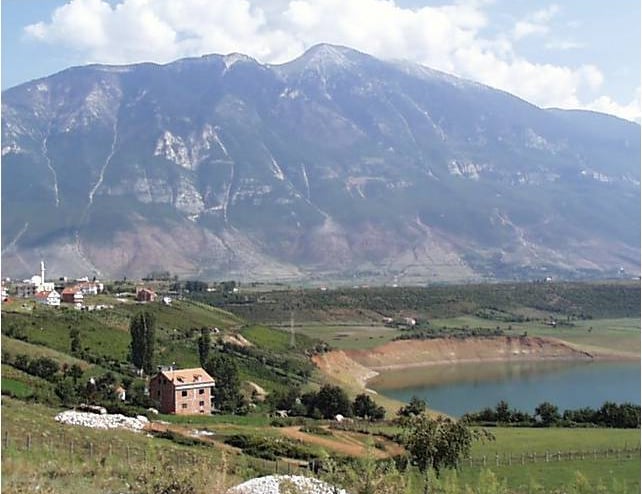
Mount Gjallica, one of Albania's many mountains
A Literature Shaped by Independence
Histoire des Albanais by Serge Métais provides the essential keys to understanding 19th- and 20th-century Albanian literature, centring its account on Albanian independence, which began with the construction of a national identity built around the Albanian language.
This independence is also the central theme of Le luth des montagnes by Gjergj Fishta, who was one of those who took part in establishing the Albanian alphabet, and one of the earliest champions of Albanian nationalism, directed against the Ottoman Empire. Le luth des montagnes is a poem recounting the struggle of Albania — at the time a territory of the Ottoman Empire — against Montenegro's attempt to annex it. If one is prepared to absorb 600 pages of epic poetry, it is an excellent way to discover Albanian folklore, which the author draws on extensively. The story of Le luth des montagnes spans from Montenegro's invasion of Albania, carried out with Ottoman consent, through to Albanian independence.
This same spirit of defiance toward the Ottoman Empire can also be found in Bardha de Témal by Pashko Vasa, a close associate of Gjergj Fishta.
The Communist Period
Communism in Albania
Speaking of Albania without addressing its decades of communist dictatorship is almost impossible. To learn more about this specific period, I read L'Albanie d'Enver Hoxa by Gabriel Jandot and Contre le révisionnisme by Enver Hoxha or one of his ghostwriters. The former, unfortunately, does not so much describe life in Albania under Hoxha as it does his ideology. The reason given by the author is the country's closure during the dictatorship and the filtering of information coming out — not to mention that all internal Albanian sources were "corrected" along the way to conform to the party's needs. As a result, almost nothing remains but oral sources for understanding what life in Albania was actually like during those years.
In broad terms, Hoxhaism is an openly dictatorial, anti-democratic, totalitarian, and nationalist ideology with strong ties to Stalinism. As an aside, Enver Hoxha never forgave the USSR for abandoning Stalinist thought, and this was also one of the reasons for his falling-out with China.
One aspect of Hoxhaist thinking that struck me — discussed in L'Albanie d'Enver Hoxa and confirmed by what I read in Contre le révisionnisme — is the attachment to a single, eternal party: whether today or a thousand years from now, imagining a plurality of political parties would be a betrayal of "true" communism, even if the other permitted parties were themselves communist. In theory, this is because the communist party represents the people, who alone can govern themselves; creating other parties would be to over-represent part of the population. In practice, it conveniently justifies regular purges within the party and prevents the formation of rival factions.
Another rather ironic aspect of Albanian communism's genesis is this: the Albanian Labour Party (the communist party) was formed in the 1940s to defend Albania's proletarians. Yet at that time, Albania was a barely industrialised country — factories could almost be counted on one hand — meaning there were virtually no proletarians to speak of. As a result, one of the party's first self-assigned missions was to industrialise the country, thereby creating the very proletarians it had set out to defend.
Gabriel Jandot, in conducting his study, visited Albania multiple times — both during the communist period and after — to meet and speak with people who had lived through the dictatorship. The regime had already been crumbling at Hoxha's death before collapsing entirely in 1991; this is a recent event, and many Albanians remember that period vividly. The memories left behind are far from clear-cut: you find nostalgics, people who held high positions in the party and are now concealing that fact, people traumatised by the secret police and forced labour, and so on. I had feared a book lacking in objectivity, and the tone occasionally gives that impression. Nonetheless, what Jandot reports of Hoxha's thinking aligns with what I read in Contre le révisionnisme, so I recommend this book. Contre le révisionnisme, however, I do not particularly recommend — extremely verbose, near-impossible to contextualise without outside help, consisting of nothing but speeches and political commentary, and not even that easy to find.
The Literature of This Period
I read six books from this period, written by its most representative authors: Ismaïl Kadaré and Dritëro Agolli.
Ismaïl Kadaré, whom I had believed to have been a lifelong opponent of Enver Hoxha, undoubtedly has a more complex history than I assumed — according to Gabriel Jandot, he served as Vice-President of one of the party's institutes of Marxist ideology.
Unsurprisingly, I enjoyed Le Général de l'armée morte, which presents a facet of war that is often passed over in silence: the distant aftermath, once tensions have subsided, when the bodies must be repatriated. Kadaré offers a fine portrayal of human relationships and the emotions experienced by those charged with closing this chapter of armed conflict. It is also an occasion to reflect on the legacy of war: how to relate to these strangers, how to honour their memory — and indeed, whether their memory should be honoured at all.
I enjoyed Avril brisé even more. It tells a quintessentially Albanian story: a young man must settle a blood debt that has fallen to his family. The blood feud was a serious matter in the Albanian mountains, surrounded by social rituals binding families to one another and codified in the Kanun, the customary law. Avril brisé's approach is fairly naturalistic, without sentimentalism — which is justified by the plot: the protagonist is not certain what began the cycle of vendettas between his family and that of his intended victim. What he does know is that he and his kin will face the gravest of dishonours if he fails to fulfil his obligation. The system is explained with precision by the author, who weaves in a parallel story of a couple from the city discovering the vendetta system during their honeymoon. On the subject of the blood feud, I find that Avril brisé pairs very well with Bardha de Témal by Pashko Vasa, which offers a critical reading of the practice, and with Dritëro Agolli's L'homme au canon, which takes a rather cynical view of it.
I was unable, however, to finish Le concert. I read half of it — 300 pages — but could not find the motivation to push through to the end. I found no particular energy in this novel; the pace is extremely slow, and the subject matter very muddled.
Dritëro Agolli was one of my finest discoveries. His poetry (A fleur de fables) is pleasant, but what truly impressed me was his fiction.
L'homme au canon is a vendetta story, yet one that runs counter to the usual Albanian narratives on this theme: the hero is far from heroic, even if he claims otherwise in the customary register. I greatly appreciated the way the author builds up his character's sense of grandeur — he does, after all, own a cannon — only to deflate it with mockery. Many themes are touched upon in this short novel: friendship, the weight of tradition, emigration, war, humiliation, honour, and love. It is dense, well-paced, and the plot, though classical, keeps the reader hooked until the end. An excellent book, in short.
Splendeur et décadence du camarade Zulo is even more accomplished in the vein of deflated greatness. With considerable humour, Agolli presents Comrade Zulo, a bureaucrat of the communist period who divides opinion: venerated by some colleagues, unbearable to others. We follow his career, his relationships with colleagues and family, and gradually find ourselves wondering, alongside his peers, whether Comrade Zulo is a hero or a man who deserves to be sidelined.
Agolli has a strong gift for depicting human relationships, seasoning them with irony and exaggeration in a way that makes the text ring very true. On the professional side of Comrade Zulo's story, I feel this novel captures the atmosphere of communist bureaucracy — its rituals, its debates, its petty stakes. In my view, it is one of the most recommendable reads, and I will seek out more of Agolli's work if the opportunity arises.
I should mention at this point Métamorphose d'une capitale by Ylljet Aliçka, the spiritual sequel to Splendeur et décadence du camarade Zulo. Where Comrade Zulo moves through an Albania in the full swing of communism, we follow the Bendo family from the death of Enver Hoxha onwards, as the regime begins to crumble. The Bendo family is a kaleidoscope of life trajectories in Albania during that period: former high-ranking party officials, frustrated poets, former prisoners, committed activists, new Euro-communists, exiles, and more. How can all these people find their place in the new Albania? Aliçka's tone is very similar to Agolli's, and I believe that is why I enjoyed it so much — I only regret not having more of his books. He also has a remarkable gift for the well-turned phrase: faced with two grave-robbers, for example, one character observes: "Hell cannot compete with this landscape."
Three Scattered Reads
Bardha de Témal : scènes de la vie albanaise by Pashko Vasa is a pleasant read. A love story as well as a tale of vendetta, it is above all a political work: a critique of the Ottoman Empire. At the time it was written (1890), there was not yet an Albanian nation; while the Ghegs and the Tosks both lived in Albania, there was no real sense of Albanian identity. The reasons for this are multiple, but one of the goals of the League of Prizren — to which Pashko Vasa belonged alongside Gjergj Fishta — was to remedy this, with a view to claiming independence from the Ottoman Empire as a second step. The narrative of Bardha de Témal is thus the occasion for several passionate speeches against Ottoman rule. This is also why Vasa is critical of the vendetta: he wants the clashes between Albanians to stop so that they may unite against the Empire. On its own terms, the plot is well-handled, and the read is enjoyable quite apart from its historical context.
Tirana Blues by Fatos Kongoli: I will say very little — the novel's premise is good, but I did not enjoy the writing style at all.
The same cannot be said of Soleil brûlé by Elvira Dones, which follows the lives of Albanian women forcibly recruited into a prostitution network in Italy, run by Albanians. From a literary standpoint, the style is remarkable, and the use of multiple characters allows Dones to achieve interesting variations depending on each situation. The violence is not concealed — quite the contrary, it is described in stark, cold terms, without sentimentality, which makes those moments of horror all the more striking. Structurally, I found the multiplicity of characters effective, as it conveys the multiplicity of circumstances that brought them there. Above all, while the abducted and trafficked women are clearly the novel's "main characters," their pimps are also described at length, as are some clients and the authorities. This creates a fairly comprehensive picture of the situation. Finally, there is a striking effect: the novel is long — over 600 pages — and the further one reads, the more it feels as though an entire lifetime has elapsed since the story began, even though everything unfolds over just two years.
The Best for Last?
When I want to understand a subject, I always turn to academic books written by scholars. It is the best way to obtain reliable information, placed in context and interpreted with as little sensationalism as possible. This method has never yet let me down: whenever I read an academic book, I finish it feeling that I know more about the subject than I did before.
I therefore expected that by reading Bektachiyya, études sur l'ordre mystique des bektachis et les groupes relevant de Hadji Bektach by Alexandre Popovic and Gilles Veinstein — a collection of academic articles on Bektashism — I would come away knowing more about it: a fairly clear picture of Bektashi rites, the structure of their beliefs, an approximate number of practitioners, their traditions, the key texts of their faith, and so on.
What I learned instead is that Bektashism developed within a culture of secrecy. From my understanding, Bektashism has Islam and pre-Islamic Turkish beliefs as its parents, and was born in the 13th century. Following persecutions, members of the Bektashi order began practising in secret, nourishing themselves on Sufism but also drawing on other influences — including Freemasonry in the 18th and 19th centuries — which further reinforced this culture of concealment.
Surprisingly, the secrecy appears to be scrupulously maintained. Moreover, Bektashism rests on very few written sources and has itself produced few archives. Notably, Bektashism is not mentioned in any of the other books I read about Albania, and its presence can only be recognised by someone already well acquainted with it.
As a result, what is known of Bektashism (in French- and English-language sources) relies heavily on cautious inference, analysis of testimonies, careful examination of tekke architecture (the monasteries, which can be mistaken for ordinary Sufi monasteries) that can be identified as Bektashi, and on the few practitioners who have written on the subject.
In the end, reading Bektachiyya gives one the impression of discovering a hidden world — or rather, of learning that a hidden world exists, without being able to know what it truly contains. Pushing the analogy further, I felt like one of Lovecraft's characters stumbling upon an ancient cult, unable to comprehend it. This sensation is reinforced by the sheer number of footnotes sourcing the researchers' claims, as these refer almost exclusively to articles in Turkish; the few French- or English-language references do not deal directly with Bektashism, making it exceptionally difficult to explore the subject further.
This reading left me with a sense of existence as an impenetrable mystery — and it is for this reason one of the most remarkable books I have ever read. Of course, this is only my own experience: Turkish or Albanian speakers will have no difficulty learning far more than I was able to.
And now — onward to Algeria!