

Fourth Journey : Albania
First journey to a European country!
11/15/2025
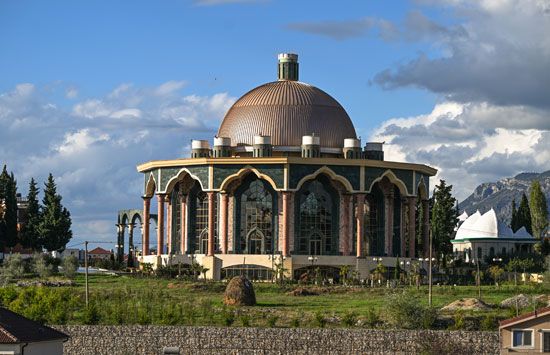
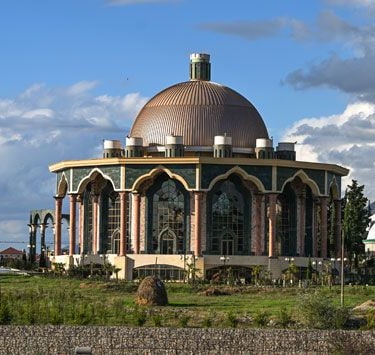
Kryegjyshata, the World Centre of Bektashism, in Tirana.
Where It All Began
Albania is a symbolic milestone for Voyages Livresques, because it was through this country that the idea for the project was born.
Some time ago, while reading L’alcool dans les mondes musulmans. Histoire, lieux, pratiques et politiques (XVe-XXIe siècle), issue 151 of the Revue des mondes musulmans et de la Méditerranée, a collection of articles edited by Nessim Znaien and Philippe Bourmaud, I discovered Bektashism. An article by Gianfranco Bria (available in open access), L’alcool entre déculturation religieuse et héritage soufi chez les musulmans albanais à l’époque postsocialiste, presents in essence the Bektashi order — a current of Islam that incorporates raki (an anise-flavoured grape brandy) into its religious practice — found primarily in Albania. Albania is itself experiencing a religious revival following the fall of Enver Hoxha's communist regime, which so aggressively persecuted religion that Albania proclaimed itself "the world's first atheist state." It is worth noting that Enver Hoxha was born into a Muslim family with ties to the Bektashi order.
This history was entirely unknown to me, and made me realise just how vast and story-rich the world is. It was in wanting to learn more, and in questioning what method to adopt to unearth such knowledge, that the idea for Voyages Livresques was born.
Although relatively unknown in France, Bektashism has gained enormous prominence in Albania, to the point where the government is studying the possibility of establishing the equivalent of a Vatican for this movement. The images illustrating this article show the Kryegjyshata, the World Centre of Bektashism, which would eventually become a micro-state enclaved within Tirana.
It is therefore natural that after reading Histoire des Albanais by Serge Métais, a general overview of Albanian history, I should turn to Bektachiyya, études sur l'ordre mystique des bektachis et les groupes relevant de Hadji Bektach by Alexandre Popovic and Gilles Veinstein. This is one of only two French-language works dealing specifically with the Bektashis, and the English-language literature is hardly more abundant.
To round off my survey of the sociological and historical context, I will look more specifically at Enver Hoxha, communist dictator of Albania from 1945 to 1985. I have chosen L'Albanie d'Enver Hoxa (1944–1985) by Gabriel Jandot, a doctor of history, and a book by Enver Hoxha, Contre le révisionnisme, to get a clearer sense of his doctrine. Between Contre le révisionnisme and Bektachiyya, I have rarely had such difficulty finding books — both were printed in very small runs and have never been reprinted.
Ismaïl Kadaré, the obvious gateway...
Probably the best-known Albanian author in France, Ismaïl Kadaré also boasts a near-endless bibliography, with around fifty works honoured with literary distinctions in a staggering number of countries. Attempting to describe this monument here is an impossible mission, and the simplest thing is to direct you to his Wikipedia page, which is richly detailed.
My first choice fell on Le Général de l'armée morte, his debut novel, which brought him international success following its French translation — so it seemed natural to use this as a bridge. As for how to choose among his other fifty works, I considered picking at random, but ultimately the Albanian government did that selection work for me by banning Le concert for seven years — a novel dealing with Sino-Albanian relations in the 1970s. I reasoned that if it was censored, it must be worth reading. There is also a coherence with Le Général de l'armée morte, as it was likewise translated by Jusuf Vrioni, Kadaré's long-standing translator.
For a reason I have since forgotten, I also have Avril brisé on my desk — a novel of blood feud. At a glance, I kept it to discover the kulla towers, Ottoman tower-houses used as places of refuge when needed.
An anecdote I discovered while writing these lines: Enver Hoxha and Ismaïl Kadaré, his unwavering adversary, were both born in Gjirokastër, a city of 25,000 inhabitants located quite far from Tirana. At the time, the city was small enough that the Kadaré family knew the Hoxha family.
...but not the first literary port of call
As I write these lines, I have already begun reading Histoire des albanais, and contrary to what I expected, I will not begin Albanian literature with Ismaïl Kadaré but with Le luth des montagnes by Gjergj Fishta. I had retained it for its reputation as a "militant" work of Albanian literature, and for Fishta's profile as a Catholic in a country that was predominantly Orthodox and Muslim. At the time of my selection, however, I lacked information and missed the most important detail. Although the Albanian language has been spoken for a very long time, its written form was standardised relatively recently, with several competing systems coexisting (Arabic, Latin, Greek scripts, and various combinations). Gjergj Fishta was president of the commission tasked with establishing an alphabet for the Albanian language, with the primary aim of promoting education in Albanian and fostering the development of Albanian literature.
Given the dates of composition of his book and the work of that commission, it is highly probable that Le luth des montagnes is one of the first books written in "unified" Albanian — making it the most coherent literary starting point.
Another monument of Albanian literature
While internationally Ismaïl Kadaré is the best-known Albanian author, he is not without a rival at home. Dritëro Agolli enjoys a reputation in Albania equal to Kadaré's, while differing from him on one key point: whereas Kadaré opposed the Hoxha regime, Agolli spent fifteen years working for a newspaper in the service of that regime. He also taught stylistics at university, and his poems are recognised for their technical mastery and lyricism.
Although several of his works have been translated into French, his writing remains relatively little-known in our part of the world. I therefore made my choices somewhat at random:
L'homme au canon, a novel set at the end of the Second World War,
Splendeur et décadence du camarade Zulo, published in serial form in a satirical newspaper in 1972 and a bestseller,
A fleur de fables, a poetry collection, since it is in this genre that he first made his name.
And finally, a small bouquet of discoveries
To close this survey of Albania, I will turn to four works.
Tirana Blues by Fatos Kongoli, a mathematician by training, whose story is set in 2003, giving a sense of life in contemporary Albania.
Soleil brûlé by Elvira Dones, with the distinctive feature of being written in Italian. Elvira Dones chose to flee Hoxha's Albania in 1988 and live abroad. The regime sentenced her in absentia to life imprisonment for this choice. This book deals with prostitution networks between Italy and Albania.
Métamorphose d'une capitale by Ylljet Aliçka, a former Albanian ambassador to France, published in 2021, in the tradition of post-dictatorship literature.
And, by contrast, Bardha de Témal : scènes de la vie albanaise written by Pashko Vasa under the pseudonym Albanus Albano, composed before Albanian independence. Pashko Vasa was a member of the League of Prizren and was thoroughly committed to Albanian nationalism. I hope to discover through it how Albanians lived and what their cultures were at the end of the 19th century.
See you soon for the reading journal!