

Fifth Journey : Algeria
First encounter with Francophone literature!
2/1/2026
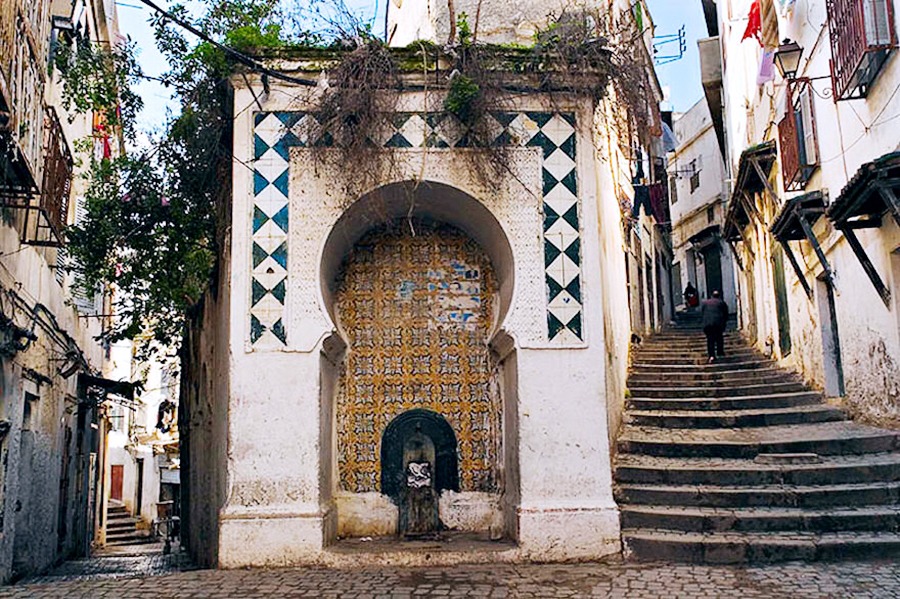
Fountain of the Casbah in Algiers
Discovering Algeria
Algeria is a country I know very little about. As with previous journeys, let us begin with a little history and culture.
First contact with French colonisation
It is impossible to approach Algerian literature and history without addressing French colonisation, which is why the first three books of this journey will be more or less directly devoted to it:
Histoire de l'Algérie coloniale by Benjamin Stora
Histoire de l'Algérie depuis l'indépendancee by the same author
Sociologie de l'Algérie by Pierre Bourdieu. Worth noting: this was Pierre Bourdieu's very first book, published in 1958.
Some more specific subjects
Alongside these, I have chosen to read Les archs tribus berbères de Kabylie, Histoire, résistance, culture et démocratie by Youcef Allioui, dealing with the history of the Kabyle tribes, an important ethnic group in Algeria. In the same vein, I have also kept L'olivier en Kabylie entre mythes et réalités by Rachid Oulebsir, whose title appealed to me.
To close this anthropological section, I will read Possession, magie et prophétie en Algérie by Aissa Ouitis, which is the abridged version of his doctoral thesis on the subject.
The Trap of Algerian Literature
Algerian literature harbours a trap for French readers: that of accidentally reading only the literature of French-speaking Algerians. It is easy to fall into, given how accessible this body of work is from France — I did my best to avoid this pitfall.
Oral traditions in Algeria
When possible, I always try to find the traditional stories and folktales of a people. Since these belong to oral culture, they can sometimes be difficult to access, but for Algeria I am well served:
Contes bédouins d'Algérie collected by Messouda and Mira Hamrit. This is a foretaste of what I may read in Sudan, where the Bedouin population is far larger.
Contes kabyles des Babors collected by Massinissa Garaoun.
Chants berbères de Kabylie collected by Jean Amrouche. Collections of songs are extremely rare — I am genuinely delighted to have found one.
The Literature
For my literary itinerary, I have selected 10 authors, grouped arbitrarily into three categories — far from watertight — for the sake of presentation. I have tried to identify each author's most recognised work, which may not always match the category heading I have given.
The Opponents of Colonisation
This first group includes:
Mouloud Feraoun, for whom I have chosen Le fils du pauvre. A French-language writer, he was assassinated by the Organisation de l'armée secrète just days before the ceasefire in 1962.
Kateb Yacine saw language as a battlefield against the coloniser and intended to use French to create a poetics specific to the Maghreb. I will read Nedjma (1956), which some describe as the founding act of Algerian literature in the French language.
Rachid Boudjedra took part in the struggle against French colonisation and served as an ambassador of the National Liberation Front in Spain. I hesitated to place him in the second group given his openly atheist positions, which brought him threats and violence. From his bibliography, I have chosen La répudiation.
Witnesses of the Black Decade
The Black Decade is the name given to the civil war that ravaged Algeria between 1992 and 2002, pitting the Algerian government against the Islamic Salvation Front (FIS) and various other Islamist groups seeking to establish an Islamic republic. This war caused approximately 150,000 deaths and is a major event in Algeria's recent history. Among the writers who lived through this period, I have selected:
Rachid Mimouni, who went into exile in Morocco in 1993 following death threats. Jules Roy cites Rachid Boudjedra denouncing the desecration of Mimouni's grave and body after his death in 1995, though I was unable to verify this information. At the very least, the rumour illustrates Mimouni's opposition to the FIS. From his work, I have chosen Le fleuve détourné.
Tahar Djaout, journalist, poet, and novelist, was openly critical of Islamist organisations. He would die from the effects of an assassination attempt in 1993 (two bullets fired point-blank to the head), an attack accompanied by a FIS communiqué denouncing his "communism and visceral hatred of Islam." I have selected Les Vigiles from his bibliography.
Boualem Sansal began writing at the encouragement of Rachid Mimouni, and his first book is Le serment des barbares, which I will read. For context, this novel was written in 1997, in the midst of the Black Decade.
The Experimenters
I struggled to name this group, which brings together authors remarkable first and foremost for their contributions to literature. Several of those mentioned above could belong here — Kateb Yacine in particular — but I had to make choices to balance the presentation.
Mohammed Dib wrote (in French) novels, children's stories, poetry, short stories, and plays, and dedicated his life to literature. Finding a single representative work in his bibliography (30 volumes and 41 archival boxes at the BNF, not counting his early work) is quite impossible. I chose more or less at random La maison vide, the first volume of the Algeria trilogy, published in 1952. La maison vide was an enormous success and has been reprinted every year since. If I enjoy it, I will read the rest.
Mouloud Mammeri is a linguist specialising in the Amazigh language and culture. It is this expertise that interested me, and I will read L'opium et le bâton by him.
Tahar Ouettar is an Arabic-language novelist considered one of the founders of the modern Algerian novel. It is on the basis of this reputation that I chose him; from his works, I selected Noces de mulet.
A compilation of poems by Si Mohand, who died in 1905 and whose poems were collected by Mouloud Feraoun. Si Mohand would recite his poems aloud, leaving it to his listeners to write them down if they wished to preserve them.
Ahlam Mosteghanemi is the most widely read female writer in the Arab world — it would have been a shame not to try her work. From her bibliography, I will read Mémoire de la chair.